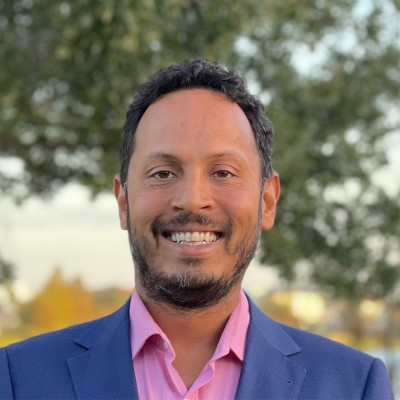
In 1989, at Fatima College in Trinidad, a fourteen-year-old taught himself BASIC on a TANDY TRS-80. Five years later he built PowerStat, a GUI for tracking dengue outbreaks across the island. It won best in country at the Caribbean Examinations Council and was reviewed in Barbados. He was sixteen.
What followed was a decade at the University of Pennsylvania: an MD, a PhD in Genomics and Computational Biology, and a master's in Systems Engineering. The training sat at the exact intersection of medicine and computation, and it clarified something that would take another ten years to fully articulate: the problem in healthcare AI was never the science. It was the absence of infrastructure to govern it.
At Stanford he worked in Atul Butte's lab and saw what bioinformatics looks like when the datasets are large enough to matter. At UCSF he shipped software inside a hospital system and learned what compliance actually costs when patients are on the other end. At the University of Central Florida he became the Founding Chief of AI and built an institutional program from an empty office. Each position confirmed the same thesis. Governance is not an overhead line on a budget. It is the product.
On January 5, 2026, he created a GitHub organization and committed nine lines. Not code. Not a README. A governance contract called CANON.md. The rules arrived before the implementation, the way a constitution is ratified before a government operates. Everything that has followed — six patent families, sixty-five publications, thirty-eight million dollars in funded research, a clinical trial registered on ClinicalTrials.gov, and 7,062 commits across fourteen years — is a consequence of those nine lines.
7,062
commits
6
patent families
$38M+
funded research